
The Meter Decides: What 219 TH/s Earns After the Power Bill
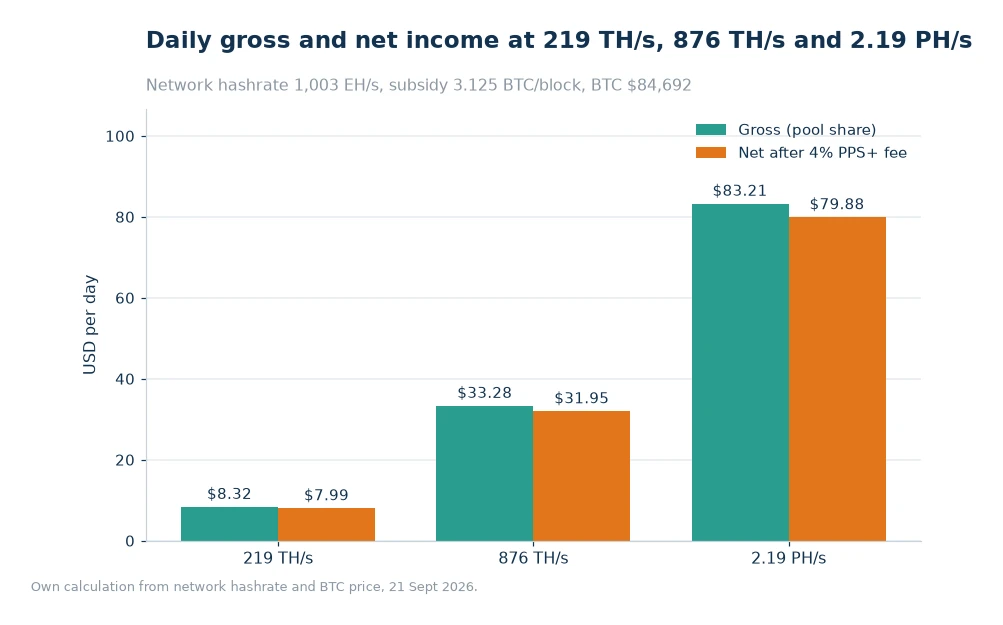
At 219 TH/s the pool credits roughly 0.00009826 BTC a day, $8.32 at $84,692, and $7.99 after the posted 4% charge on the block subsidy. Whether any of that survives depends on the wall socket. A machine pulling 4.4 kW at six cents a kilowatt-hour consumes $6.31 of that credit before the owner sees it.
Key takeaways
- Gross income at 219 TH/s is $8.32 a day; the net figure of $7.99 is what the power bill competes against.
- Efficiency is a running cost: 20 J/TH at this hashrate means 4.38 kW, or about 105 kWh every day.
- At $0.06 per kWh, power takes roughly $6.31 of a $7.99 credit, leaving about $1.68.
- Every cent on the tariff moves the daily margin by more than a dollar at this scale, which is why the rate matters as much as the hardware.
Two bills, one machine
Mining has an unusual cost structure: the revenue arrives in fractions of a coin every hour, while the expense arrives once a month in a currency the utility defines. The two numbers live on different statements and are easy to compare badly. A miner who looks only at the credit column will conclude that a machine is printing money. A miner who looks only at the power bill will conclude the opposite.
The honest view is the subtraction. Take the net credit at your hashrate, subtract the metered cost of running it, and treat what remains as the return on the hardware. Everything else — the pool's fee schedule, the machine's efficiency, the local tariff — is an input to one of those two figures.
What the pool pays before the socket
Under PPS+, the block-reward portion settles hourly against current difficulty, and the posted charge on that portion is 4%. The transaction-fee portion follows PPLNS logic with a posted 2%. Those are different components with different charges, which is why a single blended percentage is the wrong way to model income. The ViaBTC Bitcoin Mining dashboard separates them for you, and the split is worth reading once before you build a spreadsheet around it.
For planning, the net credit is enough. At 219 TH/s it is 0.00009433 BTC a day, or $7.99 at today's price. That figure already reflects the posted charges. It does not reflect power, cooling, network fees on withdrawal, or the cost of the space the machine occupies. Those belong in the expense column, and the largest of them is usually electricity.
Turning watts into a daily charge
A miner's efficiency rating, expressed in joules per terahash, converts directly into kilowatts. Multiply the hashrate in terahash by joules per terahash to get watts, then divide by a thousand for kilowatts. At 20 J/TH and 219 TH/s, that is 4,380 watts, or 4.38 kW. Over a day the machine draws 105.1 kWh.
Multiply by the tariff and the daily cost appears. At six cents that is $6.31; at nine cents it is $9.46, which is more than the pool credit. The same machine, the same hashrate, the same coin price, and two completely different businesses depending on where it is plugged in.
| Wall draw | kWh per day | Cost at $0.06/kWh | Cost at $0.09/kWh | Left at $0.06 |
|---|---|---|---|---|
| 3.0 kW | 72.0 | $4.32 | $6.48 | $3.67 |
| 4.4 kW | 105.6 | $6.34 | $9.50 | $1.65 |
| 5.5 kW | 132.0 | $7.92 | $11.88 | $0.07 |
The bottom row deserves a second look. A machine drawing 5.5 kW at six cents keeps seven cents a day before cooling, and cooling is not free. Fans inside the case are already counted in the wall draw; the room's extractor fans and the pumps in a liquid loop are not.
Break-even power is the number to memorise
Divide the net daily credit by the daily kilowatt-hours and you get the tariff at which the machine stops contributing. At 4.4 kW and $7.99 a day, the break-even tariff is about 7.6 cents per kWh. Above that, the machine is converting electricity into coins at a loss, however healthy the hashrate looks on the dashboard.
That number moves with the coin price and with difficulty, and it moves in both directions. A 10% fall in the BTC price lowers the break-even tariff by roughly the same proportion. A difficulty increase does the same thing more slowly. Recomputing the figure once a month is enough; recomputing it once a quarter is how a miner discovers in December that the machine has been underwater since August.
Why the panel matters more than the spec sheet
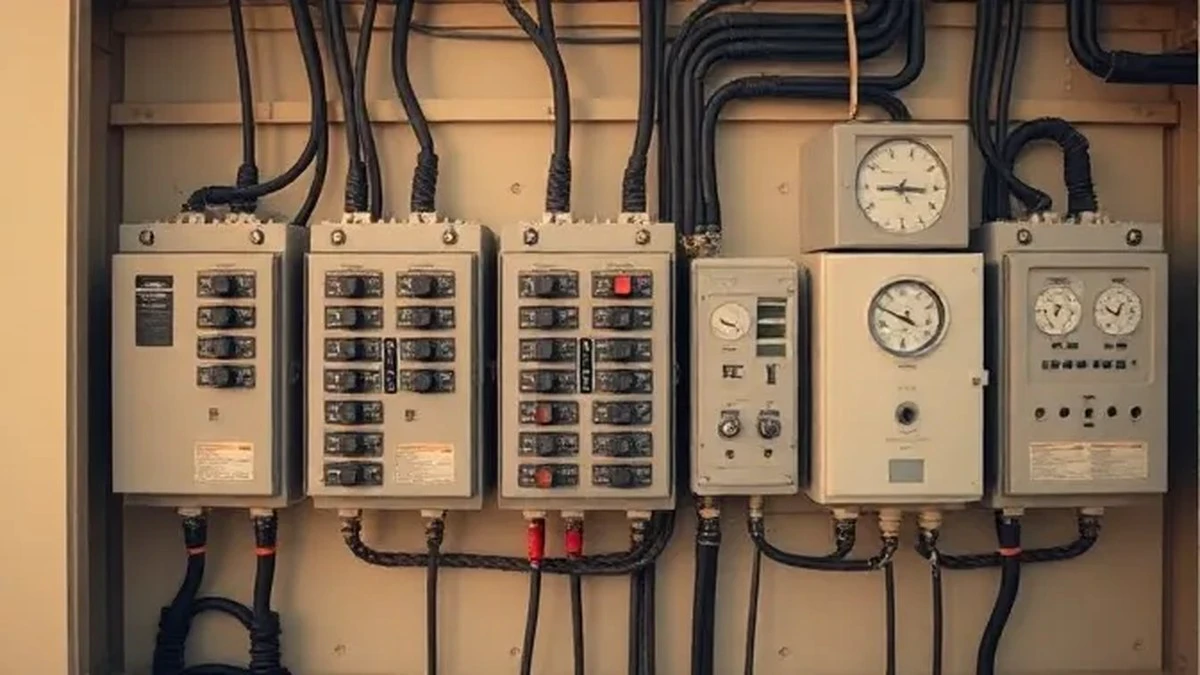
Specification sheets quote efficiency at a nominal voltage and a nominal load in a laboratory. A real circuit has voltage drop, a breaker that runs warm, and a power supply that loses a few percent in conversion. The number that pays the bill is the one a clamp meter reads at the panel, not the one printed on the box.
Measure it once when the machine is new and again after a year. A PSU that has drifted, a fan bearing that is dragging, or a dust-clogged heatsink will all show up as a higher wall draw for the same hashrate. That drift is invisible in the pool dashboard and obvious in the meter, which makes the meter the more useful instrument for an operator watching costs.
Tariffs that punish a flat load
Residential tariffs often charge more per kWh above a threshold, and many add a demand charge based on the highest half-hour of the month. A mining load is flat, which is good for the demand charge and bad for a tiered rate: the machine sits in the expensive tier all month rather than briefly. Reading the tariff schedule properly can matter more than shaving a joule off the hardware.
Time-of-use plans are the other trap. A machine that runs around the clock pays the peak rate for part of the day even though it cannot shift its work to the cheap hours without turning off. If the peak rate is double the off-peak rate, the blended cost is not the headline number on the plan.
Worked example: 219 TH/s at 20 J/TH
Follow the credit and the consumption in parallel, because the decision depends on both.
- Network output per TH/s: 450 ÷ 1,003,000,000 = 0.00000044865 BTC a day.
- 219 × 0.00000044865 = 0.00009826 BTC, or $8.32 at $84,692.
- After the 4% block-reward charge: 0.00009826 × 0.96 = 0.00009433 BTC, or $7.99.
- Power: 219 × 20 = 4,380 W = 4.38 kW; 4.38 × 24 = 105.12 kWh a day.
- At $0.06 per kWh: 105.12 × 0.06 = $6.31.
- Left over: $7.99 − $6.31 = $1.68 a day, before cooling and space.
- Break-even tariff: 7.99 ÷ 105.12 = $0.076 per kWh.
Frequently asked questions
What does 219 TH/s pay per day after fees?
About 0.00009433 BTC, or $7.99 at $84,692, once the posted 4% is applied to the block-reward component; the transaction-fee part follows its own 2% basis.
What power draw should I expect at 20 J/TH?
4.38 kW at the wall, which is 105.12 kWh a day, so the electricity bill depends almost entirely on the tariff rather than on the machine.
At what electricity price does this stop making sense?
Around 7.6 cents per kWh at these inputs, since $7.99 divided by 105.12 kWh leaves nothing above that; the figure shifts with the coin price and with difficulty.
Read the meter before the dashboard
Once a month, write down three numbers: the net credit from the pool, the kilowatt-hours from the meter, and the tariff that applies. Divide the first by the second and compare the result with the third. That single comparison tells you whether the machine is a business or a hobby, and it takes less time than reading a profitability table. The Profit Calculator can supply the credit side; the meter supplies the rest. When the two are close, check the pool state page before buying another unit.
Sources: ViaBTC pricing, calculator and pool state pages, plus chain data read 21 Sept 2026 — network hashrate 1,003 EH/s, difficulty 132.76 T, 3.125 BTC subsidy, 144 blocks a day, BTC $84,692. Efficiency and tariff figures are illustrative assumptions, not quoted rates. Published 24 Oct 2026[1].